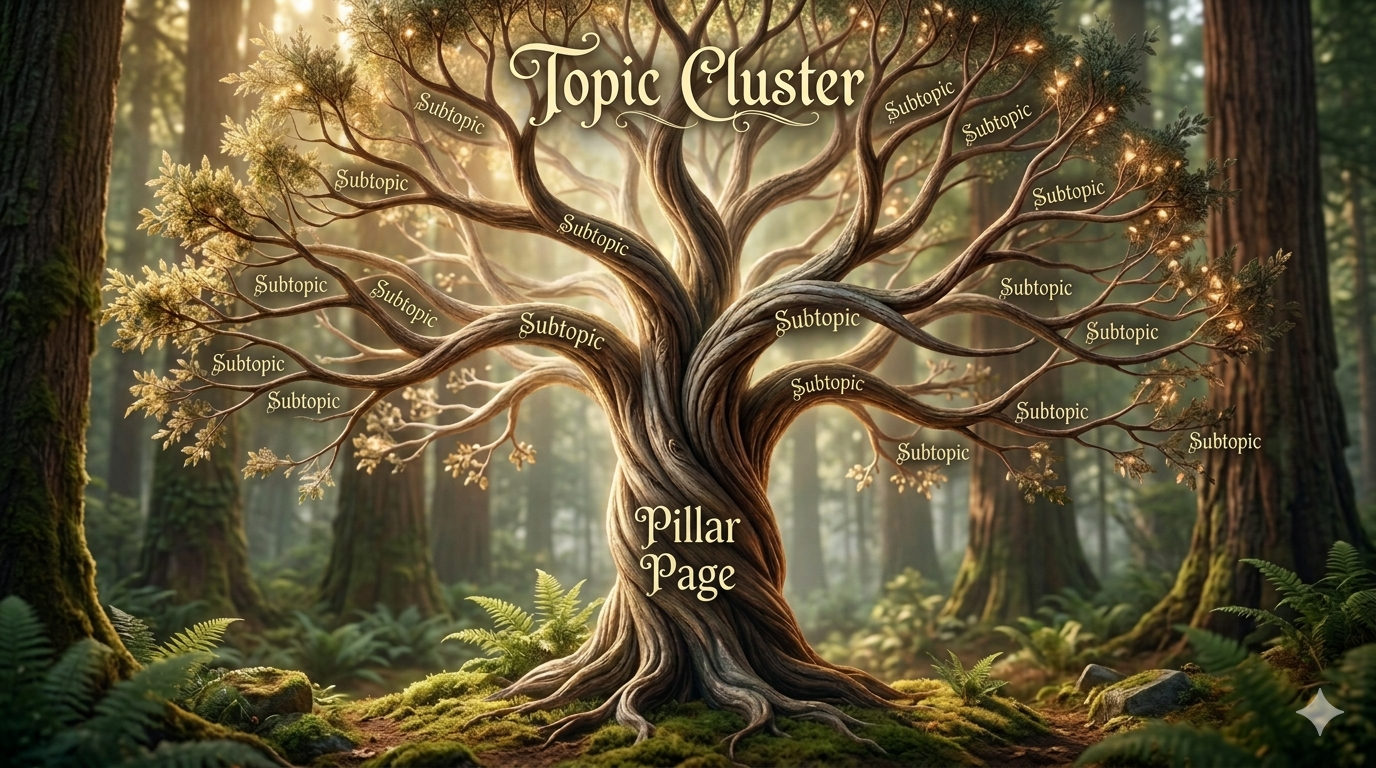
Marketers and SEO specialists have been talking about topic clusters for years—long before generative AI took off.
The term itself might sound new, but this concept has actually been around for some time.
Topic clusters can play a key role in staying relevant in today’s highly competitive blogging landscape—especially if your goal is to build authority and increase your chances of being cited in AI-generated responses.
What are topic clusters anyway, and why do they matter?
Here’s a simple guide to get you started.
What Is a Topic Cluster?
A topic cluster is a group of blog posts related to one main topic.
Basically, you choose a central subject. One that’s not too broad and not too narrow.
- Too broad: “Weight Loss”
- Too narrow: “Protein Intake for Gastric Sleeve Patients in Week 2”
- Just right: “Weight-Loss Surgery: Preparation and Recovery”
Then, you create several pieces of content about the subject that explore it in depth.
Topic clusters have two main components:
- Pillar page—a long, broad, in-depth post that covers the main topic.
- Cluster content—a series of shorter blog posts that cover various subtopics.
A pillar page and all its cluster content are connected through internal links. Linking them together helps users and search engines understand how everything fits together.
Topic clusters also support entity-based search! In other words, it supports how modern search engines understand topics and relationships between content.
The Basic Structure of a Topic Cluster
Here’s a more precise visual that demonstrates what a topic cluster looks like.

A Simple Example of a Topic Cluster
Here’s an example that brings this all together.
Let’s say your client is a bariatric surgeon with their own private practice.
Ideal topics for pillar pages might be:
- An Overview of Gastric Bypass Surgery
- Dietary Guidelines After Bariatric Surgery
- Guide to Choosing the Right Weight-Loss Surgery
These topics—which are broad, lengthy, and comprehensive—have the potential to generate lots of subtopics.
Let’s start with “Guide to Choosing the Right Weight-Loss Surgery.” I can think up dozens of subtopics that stem from this one alone, and you could build a never-ending editorial calendar.
Good supporting posts for this pillar page would be:
- Gastric Band vs Gastric Bypass: Which Is Safer?
- Which Weight-Loss Surgeries Can Be Reversed?
- What Are the Most Popular Bariatric Surgeries?
Topic clusters create a connected system of content, rather than a collection of random, unrelated posts.
Why Do Topic Clusters Matter?
Topic clusters are important for lots of reasons, and you should definitely include them in your content marketing strategy.
They Help You Build Authority and Trust
Publishing several pieces of content about a specific topic shows that you truly understand the topic. It also shows your expertise. Over time, this builds trust with users and search engines, which begin to see you as an authority in your niche, or industry.
Authority and trust are especially important for Your Money or Your Life (YMYL) topics. YMYL topics are topics that can potentially impact the health, financial stability, or safety of people, or the well-being of society.
They Improve SEO
Adding internal links to your content helps it rank higher and get discovered more easily. Your posts support one another instead of compete with one another.
They Create a Better Experience for Readers
Readers genuinely interested in learning about a subject can use topic clusters to find related content. This increases your engagement rates, as readers will stay on your website longer. It also supports reader satisfaction, and potentially, conversion.
They Provide Endless Content Ideas
Remember how I mentioned topic clusters can easily help you fill your editorial calendar? It’s true—topic clusters make for easy inspiration.
You can create a long list of related ideas and topics to work through. You’ll never get bored, and you won’t have problems figuring out what to write next.
How to Start a Topic Cluster
Starting a topic cluster is easy:
- Choose a broad topic—ideally, something related to your niche or website.
- Brainstorm a list of subtopics, or ideas related to the topic.
- Create the main pillar page.
- Create content for each of your subtopics.
- Connect all your content together using internal links.
Ta-da! I bet lots of you were already doing topic clusters and didn’t know it.
Final Thoughts
If you’ve been blogging for a while, the entire “topic cluster” concept may seem familiar. In fact, HubSpot started a conversation about topic clusters in 2017. Around the same time period, there were similar concepts floating around called “content silos” and “cornerstone content.”
I remember coming up with topic clusters for clients about 10 to 15 years ago, and tracking my subtopics in company-wide editorial calendars. This practice isn’t exactly brand-new—these concepts have simply evolved into what we now know as topic clusters.
Topic clusters may sound complex at first, but they’re not. I think this concept comes naturally to most bloggers and content marketers.
Instead of creating a bunch of random blog posts about various topics, you’re building something more helpful, structured, and valuable for your audience.
If you’d like help creating pillar pages or building out topic clusters for your site, feel free to reach out—I’d love to work with you.


Leave a Reply